Can we break the old vendor lock and build networks that move as fast as our business?
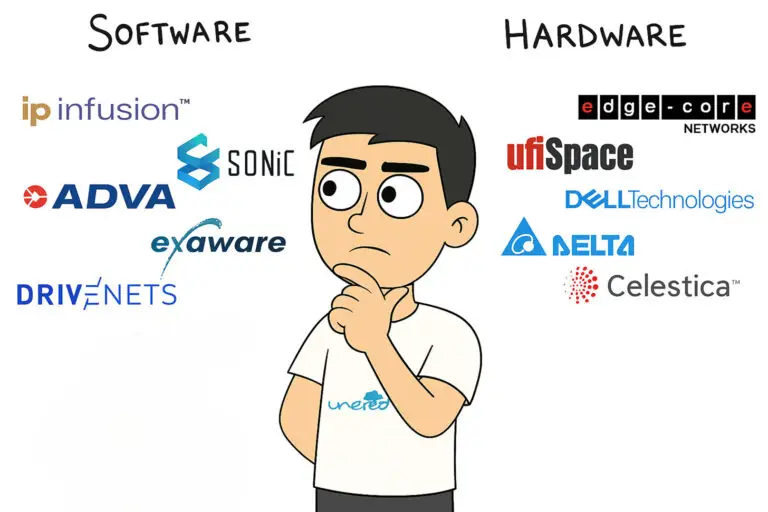
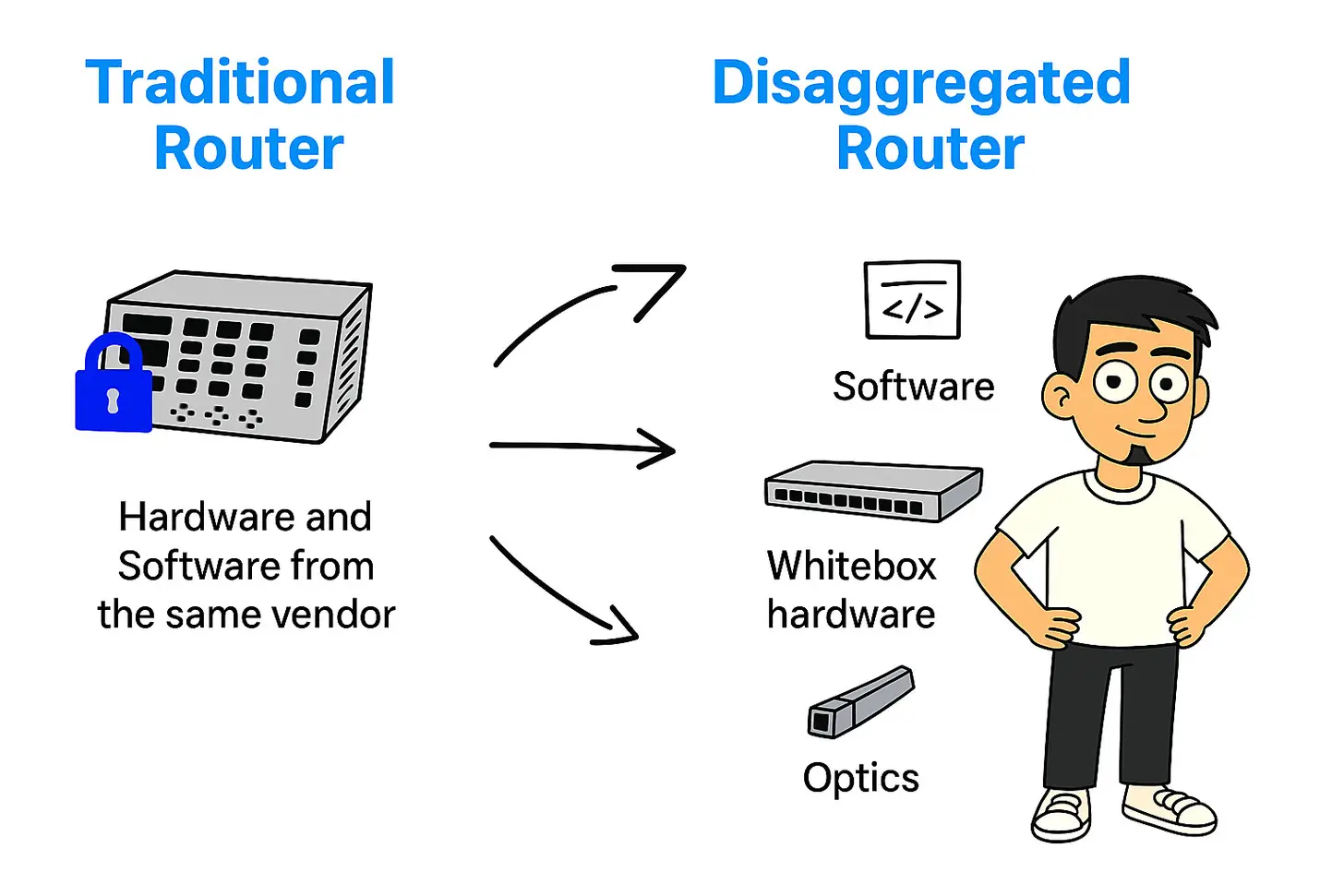
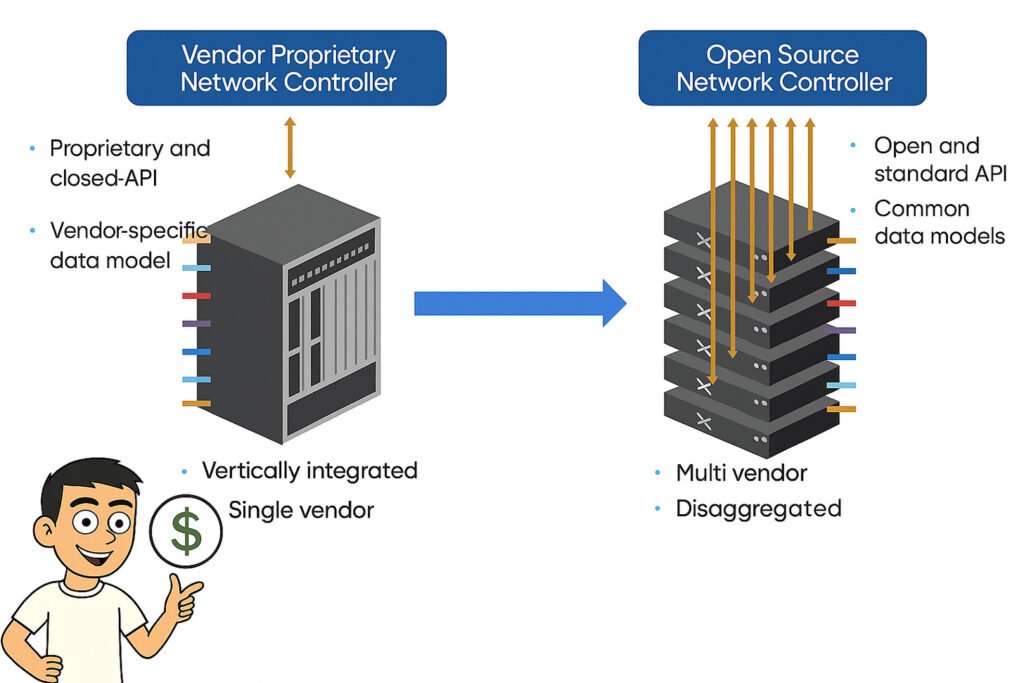
We define this change simply: decoupling hardware from software. This lets teams choose the best parts for their needs. They then assemble platforms that meet their goals.
In practice, this means we split systems into three clear elements: commodity hardware, a network operating system, and control interfaces. Each part can evolve on its own schedule without a full forklift upgrade. This shift began in hyperscale cloud and now shapes telecom and enterprise environments.
By using white box hardware, an open NOS, ONIE and open interfaces (Optics), we gain supply resilience and vendor choice. The practical benefits include faster service delivery, lower capital and operating expense (- OPEX/CAPEX), and clearer control of our roadmap.
In this post we map where this fits — Peering/Internet Gateway, Datacenter fabric, Core and Aggregation, access and routed optical — and offer clear metrics for success: cost, speed, and agility. Our aim is a concise, actionable guide for operators and decision-makers.
Key Takeaways
- Decouple hardware and software to assemble tailored systems.
- White box plus open NOS gives faster feature adoption and vendor choice.
- Proven in cloud, now standard for service providers and enterprises.
- Expect lower costs, improved lead times, and better supply resilience.
- This post gives practical steps and metrics for operators and business teams.
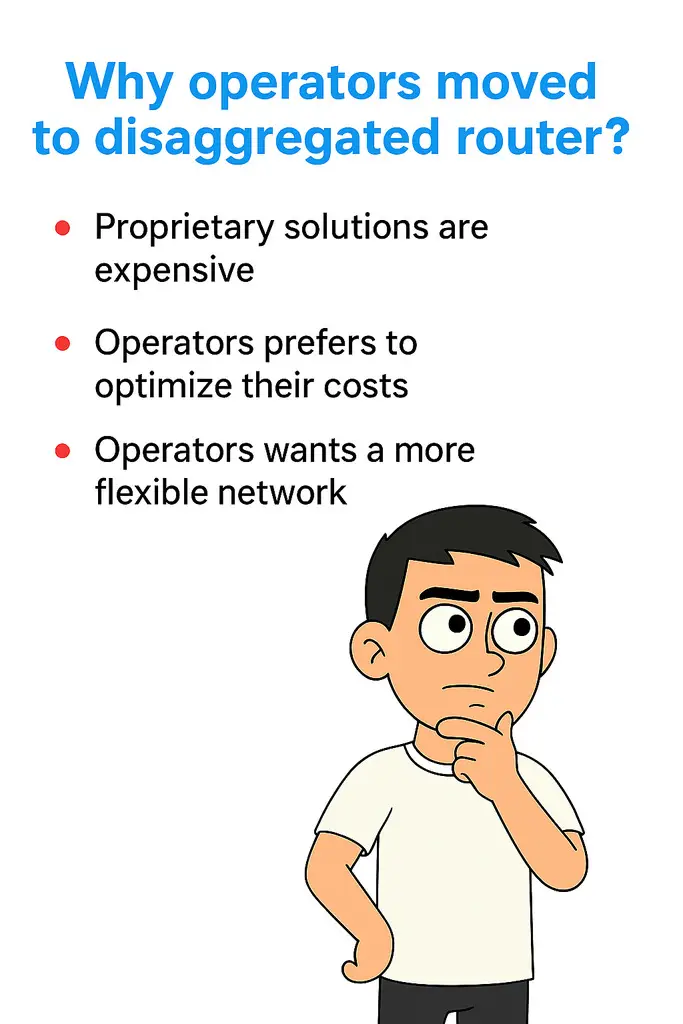
Why operators moved to Disagregated router
Telecom and IP operator teams adopted these patterns to avoid vendor lock-in and to add features faster. They gained better control over performance and could tune platforms for specific services.
Open install environments like ONIE and standard southbound APIs make mix-and-match practical. The result is reduced procurement risk, faster time-to-market, and clearer alignment of cost with capability.
| Element | What it gives us | Operational benefit |
|---|---|---|
| White box hardware | Commodity silicon and varied vendors | Lower lead times and supplier choice |
| Open NOS | Modular software, faster updates | Faster feature rollout and tuning |
| Open interfaces | Standard APIs and ONIE | Interoperability and easier validation |
We will cover core building blocks and the operational trade-offs next. Our goal is practical guidance so our business can adopt this architecture without sacrificing resilience or performance.
Cutting costs, avoiding lock-in, and improving performance
We cut costs by matching silicon profiles and NOS features to actual workloads, not overpaying for unused chassis capabilities.
This lowers total cost ownership through predictable procurement and simpler operations, while keeping our feature roadmap in-house rather than vendor-driven.
Where this approach fits in practice
Disaggregation offers clear returns across a range of domains. We pick domains that benefit most from scale-out economics and open interfaces.
| Domain | Primary benefit | Why it fits |
|---|---|---|
| Peering / Internet gateway | Optimize PPS and scale | Right silicon for packet rates |
| Data center fabric | Spine-leaf growth | Elastic scale and cost control |
| Core & aggregation | Traffic engineering agility | Flexible feature sets per site |
| Access & routed optical | Scale-out economics | IP+optics convergence choices |
- Identify the use case and scale needs.
- Map protocol, performance, and feature requirements.
- Compare platforms and model costs over three to five years.
- Phase deployment—start with peering or fabric, expand after validation.
Result: operators gain faster rollouts, measurable savings, and improved resilience by choosing the right mix of vendors and open technologies where they matter most.
Conclusion
This post closes by stressing that modular stacks let operators assemble tailored systems that meet performance goals without vendor lock.
Disaggregation drives flexible, scalable, and cost-effective designs. We highlight where it fits: peering, fabric, core, aggregation, access, and routed optical. Operators may pick the right range use cases for fast ROI.
White box hardware plus a capable NOS and open interfaces unlock choice among vendors and lower costs. The approach scales from single network functions up to full domains.
Watch this blog series and the network disaggregation blog for deployment patterns, operational checklists, and reference designs. We will help our community move from pilots into production with practical guidance on people, process, hardware, and software.